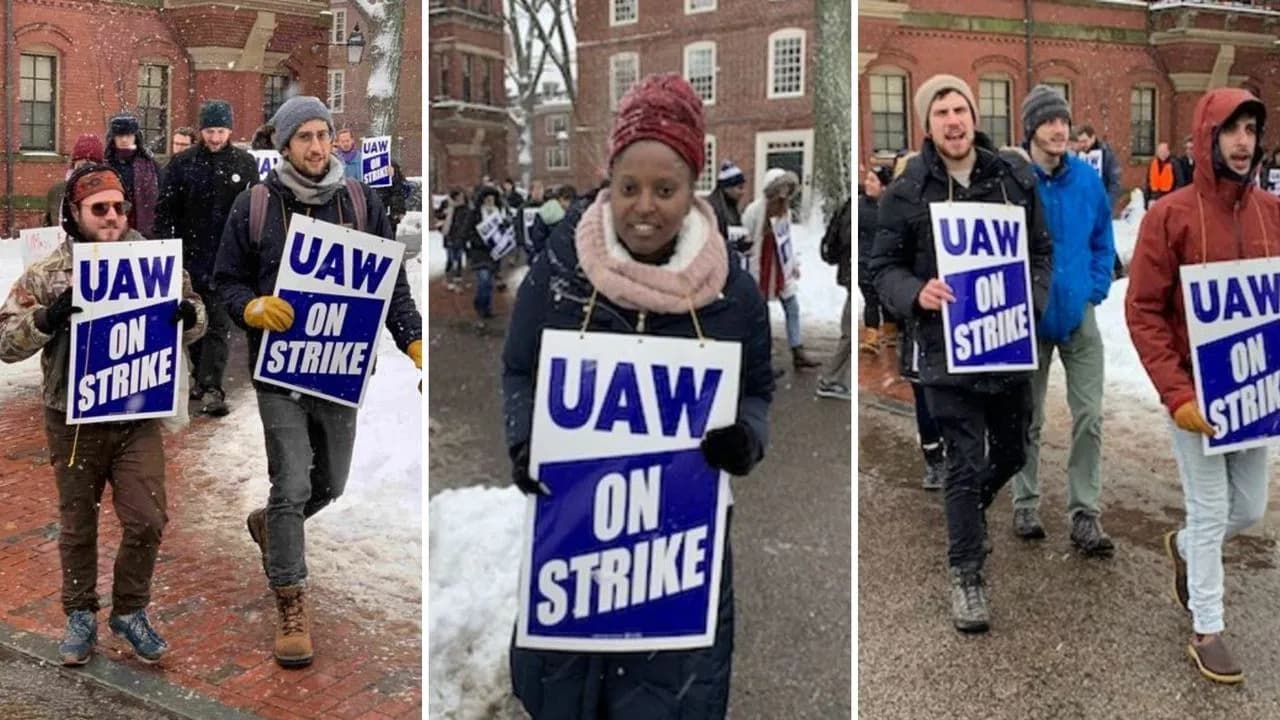
More than 4,000 graduate student workers at Harvard University walked out on strike Tuesday morning. The academic workers, members of the Harvard Graduate Student Union-United Auto Workers (HGSU-UAW), are paid so poorly that many rely on state food assistance. They are demanding wage increases to meet skyrocketing food, housing and transportation costs. Beyond living wages, they have raised a series of political demands, including protection for international students and workers from Immigration and Customs Enforcement (ICE).
I welcome and fully support the strike by academic workers at Harvard University. Your walkout is part of a growing movement of workers and young people in the United States and internationally who are entering into struggle against exploitation, repression and war.
The significance of your strike goes far beyond a contract dispute with Harvard. You are raising not only demands for higher wages and decent living conditions in one of the most expensive cities in the world, but also fundamental political demands: the defense of international students and immigrant workers, opposition to ICE repression, the protection of democratic rights and academic freedom, and opposition to the integration of universities into the military-intelligence apparatus.
These are not “separate” issues. They are all bound up with the same underlying reality: the deepening crisis of capitalism and the drive by the ruling class to impose the cost of war and economic breakdown onto the working class.
Across the country, there is mass opposition to the war against Iran, to the genocide in Gaza, and to the attacks on immigrants and democratic rights being carried out by the Trump administration. Universities have become a central battleground because students and academic workers have been at the forefront of opposing these policies. The attempt to brand opposition to war and genocide as “anti-Semitism” is a political fraud, aimed at criminalizing dissent and silencing opposition.
At Harvard and other campuses, the administration has collaborated with the government in this crackdown. This only underscores a fundamental point: the fight for basic rights—whether wages, free speech or protection from repression—inevitably becomes a political struggle against the state.
Your strike expresses this reality. By raising political demands, you are already coming into direct conflict not only with Harvard, but with the entire political establishment.
However, this also brings you into conflict with another force: the trade union bureaucracy, including the leadership of the UAW.
Workers must be warned. The UAW bureaucracy will not lead a genuine fight to broaden and win your struggle. Its entire orientation is to isolate strikes, keep them within the narrowest possible limits and subordinate workers to the political establishment.
At Harvard itself, this has already been demonstrated. Graduate student workers have been kept at the bargaining table for 14 months and have worked for nearly a year without a contract. Despite an overwhelming strike authorization, the UAW delayed calling strike action, allowing Harvard to drag out negotiations and wear down workers. This was not an accident—it reflects a deliberate effort to contain the struggle and prevent it from developing into a broader confrontation.
We have already seen the same pattern elsewhere. At Columbia University, when workers voted to strike and raised political demands, the UAW leadership refused to authorize the strike and even threatened to place the local under trusteeship. This was an attempt to silence workers and impose bureaucratic control in order to maintain the union’s relations with the Democratic Party and the government.
The same danger exists at Harvard. The bureaucracy will seek to keep your strike isolated, limit your demands, and prevent it from becoming a broader political movement.
This flows from the character of the UAW apparatus itself. It is a bureaucratic structure made up of hundreds of officials who collect salaries of more than $150,000 a year, including UAW President Shawn Fain ($276,000), Secretary Treasurer Margaret Mock ($250,633) and Region 9A Director Brandon Mancilla ($233,450). Their social position separates them from the rank and file and ties them to the institutions of corporate management and the state.
That is why it accepts the framework of contracts as an absolute limit, even when those contracts are violated by the companies. It is why it refuses to call broader strike action. And it is why it collaborates with both big business parties.
UAW President Shawn Fain has openly aligned himself with economic nationalism and has sought to collaborate with the Trump administration on trade policies. At the same time, the union apparatus remains tied to the Democratic Party, which paved the way for the current attacks on protests and democratic rights.
Workers cannot entrust their struggles to this apparatus.
The decisive question is how to expand and unify your strike. You are not alone. Autoworkers, logistics workers, healthcare workers, teachers and others are all facing the same basic issues: falling real wages, job insecurity, speedup, and the threat of war and dictatorship.
There is enormous sympathy for your struggle among workers in every industry. But this support must be consciously organized.
What is required is the development of rank-and-file committees, independent of the union bureaucracy, to link up workers across different workplaces and industries. Every worker in the UAW—and beyond—should be mobilized in support of your strike. There is no justification for isolating academic workers from industrial workers. We are all part of the same class, facing the same enemies.
Your struggle raises the need for a general strike movement against war, repression and austerity. But such a movement will not be initiated from above. It must be built from below, by workers themselves, through new forms of organization that break free from the control of the bureaucracy.
The issues you are fighting—war, dictatorship, inequality—cannot be resolved through limited reforms within capitalism. Even the most basic demands come into conflict with a system that is driven by profit, militarism and exploitation.
That is why your struggle has a broader, historic significance. It poses the necessity for a political movement of the working class against capitalism itself.
I am running for UAW president as part of an insurgent campaign of rank-and-file workers to transfer power from the bureaucracy to workers on the shop floor. This campaign is directly connected to struggles like yours. It is based on the understanding that workers must take control of their own organizations and develop an independent political movement.
The fight you are waging at Harvard is part of a growing movement that is seeking a way forward. Workers everywhere are looking for leadership, for a strategy that can unite their struggles and carry them forward.
I urge you to take up this task: to expand your strike, to link up with workers across the country and internationally, and to build new organizations of struggle that can mobilize the full strength of the working class.
Your fight is our fight. The outcome will depend on our ability to unite, organize and fight together against a common enemy.
The future belongs to the working class.
