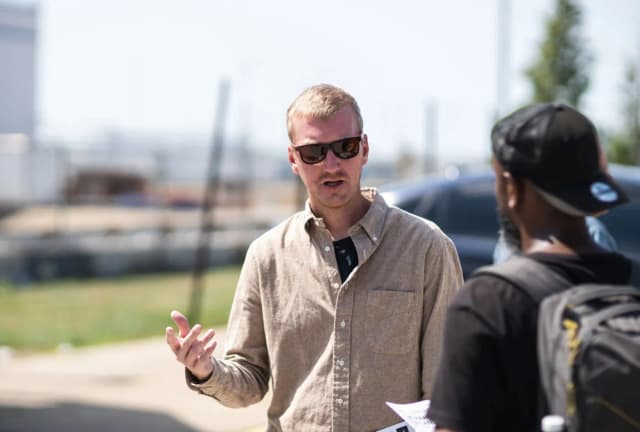
 Will Lehman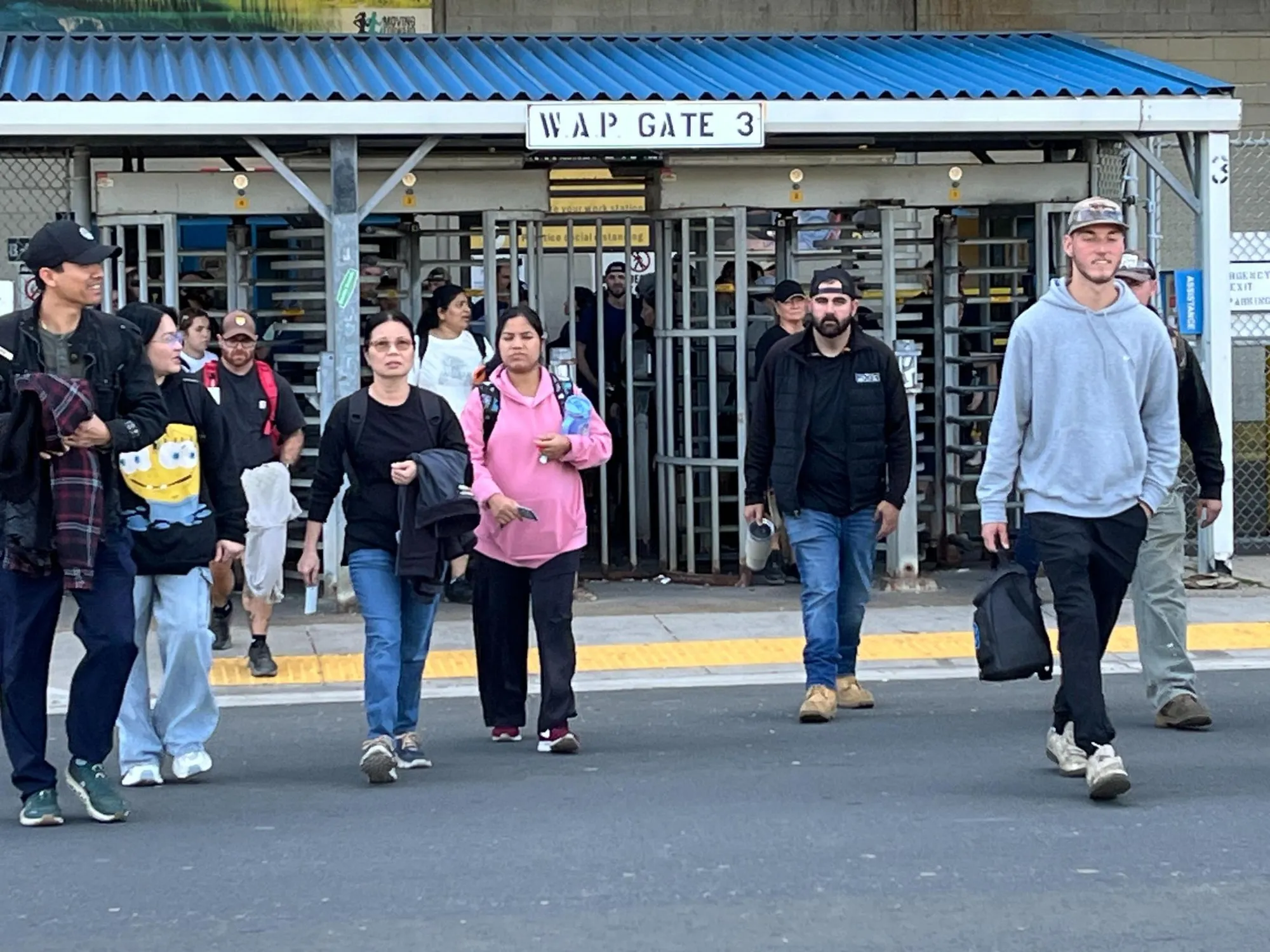
A Will Lehman campaign team on Thursday distributed hundreds of his statements, “Defend Canadian autoworkers! For cross-border action to stop the closure of Stellantis Brampton plant,” to autoworkers at the Windsor Assembly Plant, across the Detroit River from the US. Workers welcomed the statement and denounced UAW President Shawn Fain’s support for Trump’s tariffs, while expressing anger over the dragging out of negotiations with Stellantis and the refusal of the Unifor union in Canada to take any action to defend jobs.
Lehman issued the statement last week to oppose plans by Stellantis to close the Brampton, Ontario assembly plant, wiping out 2,200 jobs, and threats to cut thousands more jobs at the Etobicoke Casting and Windsor Assembly plants.
In August, the automaker reneged on its repeated pledges that the Brampton plant would reopen for production of the next-generation Jeep Compass, and on September 11 announced a memorandum of understanding to sell the plant to Roshel, a Canadian-based arms manufacturer.
Stellantis has blamed Trump’s trade war measures, including the threat to double tariffs on Canadian vehicle imports starting January 1, for the job cuts. According to the Centre for Future Work, the tariffs have led to layoffs on both sides of the border. US motor vehicle and parts manufacturers had about 43,000 fewer workers in September than in March 2025, while Canadian vehicle-parts employment fell 9.3 percent from December 2024 to December 2025.
Nearly 9,000 Stellantis workers are voting October 17-18 to authorize strike action after Unifor declared a contract “impasse” over the Brampton closure. Unifor officials have kept workers on the job for weeks after their contract expired on September 20. Unifor President Lana Payne, a member of the Carney government’s tripartite trade war advisory council, has pleaded with Industry Minister Mélanie Joly to pressure Stellantis to reverse the closure, couching the appeal in Canadian nationalist terms.
The UAW has backed Trump’s tariffs, and in October 2025 Fain hailed Stellantis’s decision to shift Compass production from Brampton to Belvidere, Illinois, as a “major victory for UAW members.” In the meantime, the promised reopening of the Belvidere plant has been delayed until at least 2028.
Workers at Windsor rejected the nationalist divisions being stoked up between Canadian and US workers. “The whole industry in North America has always been integrated,” a young worker said. “Now, throwing tariffs on, like they are a ‘Canadian product,’ it’s not fair. It’s better to be always united together, like as one supply chain and one auto manufacturer.”
He continued: “It’s been three years since Brampton has been down. I hope they bring a product there but it’s a never-ending battle because that’s how capitalism works. They want us workers to fight against each other for the penny wages. That’s how the corporation makes the biggest profit. There is no winning this way. We have to fight against cheap labor and establish a wage that all workers are supposed to earn.”
Referring to Unifor leader Lana Payne, a veteran worker said: “To be honest it’s all a show, like smoke and mirrors. I like what Will says, it’s a good initiative and hopefully will get more people involved.”
Another worker, after reading Lehman’s statement, said: “At one time US and Canadian workers were in the same union. We can’t win if we are separated. We need to get back together because the governments and companies, the big money, are destroying us.” Of the drawn-out negotiations, he said: “Unifor is putting on a show. They’re going to say they saved the third shift at Windsor, but they’ve already agreed to the closure of the Brampton plant.”
A worker with one year at the plant added: “I don’t know where I’d go if I got laid off. There is no other job that has pay and benefits like this. What they did to the Brampton workers, not keeping their promise to get a new product, was wrong. We should hold them accountable. But it’s hard to do if it’s just on a piece of paper. We’ve got another three-week shutdown coming, after being down two weeks already. Some people are living paycheck to paycheck already and are worried about a strike. We would be stuck on strike pay.”
Dan, a Windsor Assembly worker, said: “We love to have one union, brothers and sisters together. We don’t want to see Brampton closed, those are good people and we have good people here too. We’re not in 1970 anymore, automation is here, but we do have to save our jobs. For every robot that comes in there better be one guy working right beside it.”
Dan denounced the salaries of union officials, calling the UAW president’s $276,000 annual salary (CAD $392,546) “ridiculous.” Fain or any other union leaders, he said, “should be making the same thing as a production worker.” Supporting Lehman’s call for power to be transferred from the union apparatus to the shopfloor, he said, “It should be up to the people,” not corrupt union officials. “I would like to see one union, across the borders.”
Denouncing the trade war measures by Trump and the counter-tariffs by Canadian Prime Minister Mark Carney supported by Unifor, another worker said: “This is so the rich can be richer. Together, we stand. Autoworkers are always bowing to them.” Informed that a defense company was looking to take over the Brampton plant, he expressed concern over expanding military production and war. “Who owns all that? The rich.”
Noting that US and Canadian autoworkers were in the same union until the nationalist break-up in 1986, he said: “Together, we’re stronger.” On the union bureaucracies, he said: “Remember when Trump first came around Fain was against him. Whoever is in charge that’s who they go for.” Addressing workers in the US, he concluded: “Stay strong.”
Another veteran worker said: “When we are together, we are strong. When we are divided, we are weak. We should unite with workers in the US. A strike is not good but sometimes it is necessary.”
Lehman’s statement denounces Fain’s support for the tariffs and his celebration of the Compass transfer to Belvidere. “This is not a defense of American workers. It is a declaration of war on Canadian workers. It divides us and plays into the hands of the executives, who want us fighting each other while they pocket the profits.” The statement continues: “There is no such thing as an ‘American’ or ‘Canadian’ car. Every vehicle is the product of the collective labor of workers in dozens of countries.”
Lehman calls for a strike organized not by the union apparatus but by the workers themselves, through rank-and-file committees independent of the bureaucracy. Because Stellantis’s operations in Canada, the United States and Mexico are integrated, “a strike at one plant alone can be absorbed. A strike that shuts down Stellantis operations across North America cannot.”
A campaigner explained the statement’s central point: the unions in both countries say it is impossible to fight because the companies could take your job, so workers should rely on corporate-controlled politicians using tariffs and counter-tariffs. But strike action, Lehman argues, should not be limited to one plant or country. Workers in Canada, the US and Mexico must unite in a common struggle so the corporations cannot move production and whipsaw workers against each other.
The young worker said he agreed, and that the increasing trade war and militarism was “scary.” “War is not the answer,” he said.
Lehman’s statement points to the militant traditions that built the UAW as a cross-border union. In December 1936, workers at Kelsey Wheel in Windsor carried out Canada’s first recorded sit-down strike and formed UAW Local 195. In 1945, Ford workers in Windsor blockaded the streets around their plant with more than 1,500 cars to stop a police assault on their picket lines. In 1985, the bureaucracy split the Canadian section off into the Canadian Auto Workers, the forerunner of Unifor, “because the apparatus wanted to whipsaw jobs, wages, and conditions between the two countries. The way to reverse it is to build organizations of workers that ignore the border entirely.”
The statement concludes: “The working class has no country. Our enemy is not the worker across the border. It is the corporations, the banks, the governments, and the union bureaucracies that serve them. We will fight them together.”
