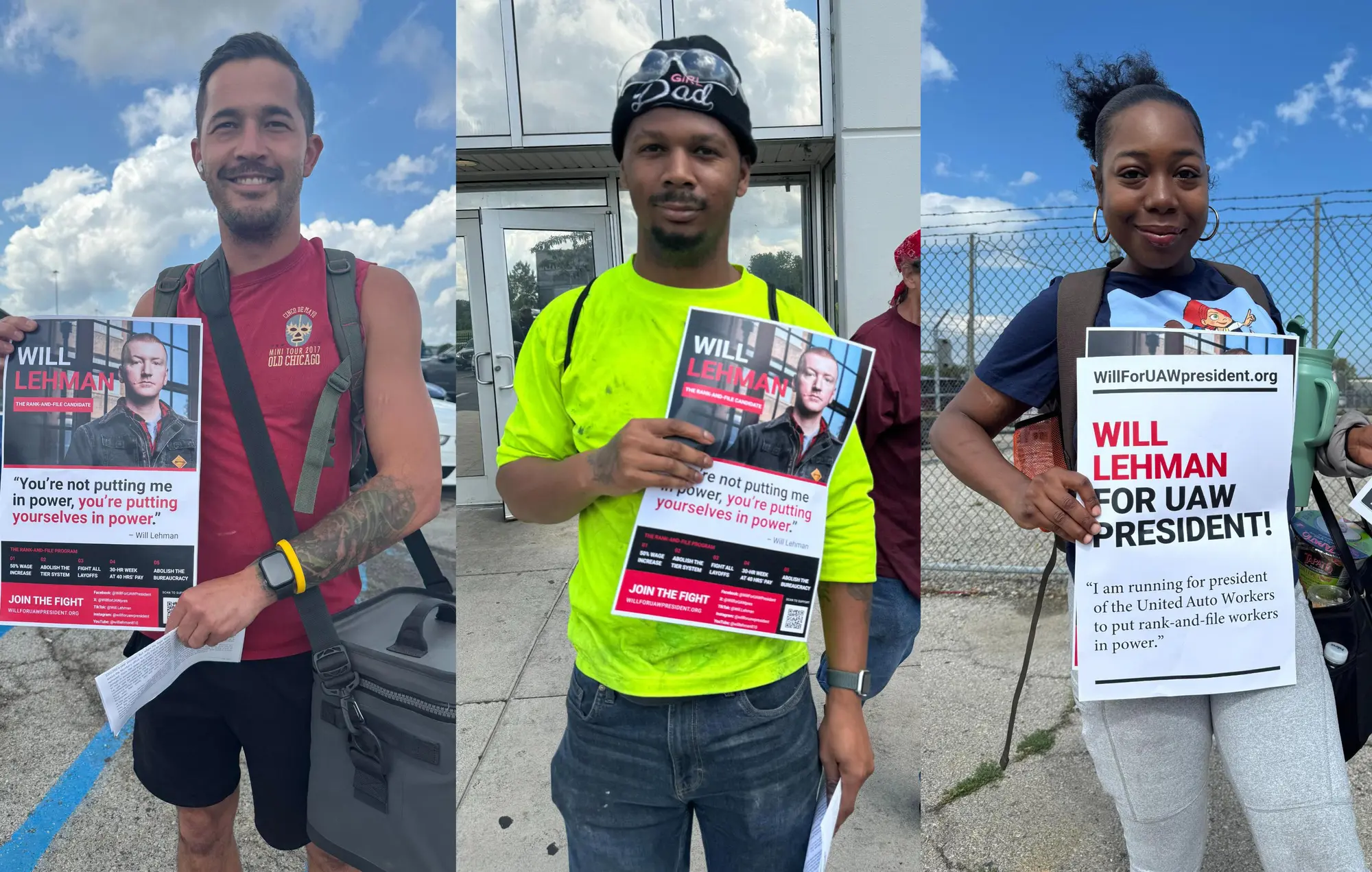
Campaigners for UAW presidential candidate Will Lehman visited the Stellantis Toledo Assembly Complex and the Dana Driveline plant this week, where they were met with an outpouring of support from workers fed up with the UAW bureaucracy’s collusion with management, deadly working conditions, and broken promises.
Workers at the Stellantis plant, who build Jeep Wranglers and Gladiators, are still living with the impact of the 2023 sellout contract negotiated by UAW President Shawn Fain and Vice President Richard Boyer. That contract, hailed as “historic” by the UAW apparatus, authorized the mass firing of temporary part-time workers who had been promised they would be rolled over to full-time positions if the deal passed. It codified seven-day workweeks under so-called “emergency status,” since used to force workers onto nine-to-ten-hour shifts with no days off for weeks at a time. And it has presided over a wave of workplace deaths and injuries that the union apparatus has made no serious effort to investigate. Three Stellantis workers have been killed on the job since the contract was signed.
Workers welcomed the campaigners, including several who voted for Lehman in his 2022 campaign. Several followed the case of Raymond Jensen Jr., the UAW International organizer who posted an AI-generated image on Lehman’s campaign Facebook page depicting him bound, gagged, and with a gun to his head. Workers expressed outrage that while the court-appointed UAW Monitor suspended Jensen from union membership for two years over the death threat, it left his employment in the hands of the Fain apparatus — and Jensen remains on the UAW payroll at $202,000 a year, paid for by the dues of the very members he threatened.
Stellantis workers are still reeling from the August 2024 death of Antonio Gaston, a 53-year-old father of four who was crushed to death at the factory. Gaston had been forced to transfer to Toledo after Stellantis indefinitely idled the Belvidere, Illinois assembly plant in early 2023, throwing over 1,300 workers onto the street.
OSHA fined Stellantis a meager $16,000 for “serious violations,” including the failure to ensure that pinch points on the chassis delivery conveyor were properly guarded — guards whose removal, had they been in place, would have prevented the tragedy. Stellantis challenged even this paltry fine, and it was reduced to just $11,000.
Gaston’s death was not an isolated case. The Toledo Assembly Complex has accounted for 30 percent of all injuries across Stellantis’s 75 North American facilities over a ten-week period last year. For nearly two months, the plant was kept under “emergency status,” with workers on nine-to-ten-hour shifts, six to seven days a week, many going more than three weeks without a day off. Exhaustion directly fueled the surge in accidents, yet the company’s response has been to conduct random safety audits to write workers up for minor infractions — shifting blame rather than addressing the conditions breaking workers’ bodies.
The “emergency status” provision was written into the 2023 UAW contract—the same contract Fain and Boyer hailed as delivering a “better work-life balance.” Section 88 authorizes continuous seven-day production and mandatory weekend work, while the “Emergencies” Memorandum of Understanding explicitly states that “there shall be no strike, picketing or other concerted activity with respect to any dispute arising out of this Memorandum of Understanding.” Fain’s contract did not eliminate these provisions; it preserved and expanded them.
“A Slap in the Face”
Two workers who transferred from Belvidere stopped to speak with Lehman campaign volunteers. Their anger at both the company and the union was unmistakable.
“I feel as if we all should be in together and we should all take a stand because there’s a lot of things that’s going on that we don’t agree with,” Vallary said. “A lot of unfair things that we’re going through, and it’s just being pushed under the rug consistently.”
Recalling the day Gaston was killed, she described the company’s callousness: “The day Antonio was killed, he was in the other building, but we didn’t find out until the end of the day that he was killed earlier that day. When workers came in they saw them actually finishing cleaning up his body. Nobody had no warning or anything. And they also had to work. So, once they finished cleaning him up, then they worked.”
Asked about the $16,000 fine for a worker’s life, she responded: “I think that’s horrible, very disrespectful and demeaning.” On the UAW officials who defend management rather than workers’ lives: “It’s a slap in the face. For us to be here at work every day and just come here and, you know, exhausting ourselves out, and it’s just being overlooked. $16,000 for a life is just very sad.”
Gaston was the first of three Stellantis workers killed under the 2023 contract. In April 2025, Ronald Adams Sr., a 63-year-old skilled trades worker, was crushed to death at the Stellantis Dundee Engine Complex, 30 miles away. And on August 1 of this year, James Brasher, a 57-year-old worker with more than 30 years seniority, fell 25 feet to his death while discarding decommissioned equipment at the Mopar Parts Distribution Center in Center Line, Michigan. His memorial service is this Saturday, August 22.
Across all three deaths, the pattern is the same: neither Stellantis, the UAW nor federal and state safety agencies have provided workers or the victims’ families with any real explanation. In recent comments to the Detroit News, UAW Stellantis Department Director Richard Boyer claimed he did not know the status of investigations the union had promised to conduct into the deaths of Gaston and Adams. The admission is a damning indictment of a union apparatus that collects millions in dues while treating the deaths of its own members as an afterthought.
The situation facing Belvidere workers exposes the fraud at the heart of the 2023 “Stand Up” strike. Workers were told the union had forced Stellantis to reopen the plant and that they would soon be able to return to Illinois. Instead, they have faced one delay after another. Stellantis announced this month that the Belvidere Assembly Plant will not reopen until 2028 or 2029 — well past the May 2028 expiration of the UAW-Stellantis national agreement, rendering the promise effectively meaningless.
UAW Local 1268 President Matt Frantzen’s response has been to tout meager concessions — back pay, extended SUB pay, continued medical coverage — while explicitly ruling out any strike action. “Striking at Belvidere does nothing to help our situation,” Frantzen declared, shifting blame to the membership for the bureaucracy’s refusal to fight. The UAW International, under Shawn Fain, has been silent.
Nathan, another Belvidere worker, who transferred to Toledo expressed his disgust: “The union being in bed with management, it’s not very helpful to us at all. And with all the people dying, yeah, I feel like we’re working in unsafe environments sometimes.” On the broken promises about reopening: “There’s been nothing. Now it’s a delay for another two years? So, I don’t even think it’s ever going to open back up, to be honest.”
He described the personal toll of being uprooted: “I’m single, no kids, so it was kind of easy for me [to transfer] but understandable for people who do have families that, yeah, had to either keep their kids and wife there, and they just come out or uproot them. Oh man, I couldn’t imagine trying to do that.”
When asked about Lehman’s campaign and his fight for rank-and-file workers to have decision-making power, not union officials making hundreds of thousands of dollars, the worker responded: “I like that a lot more. It seems like we could probably get stuff fixed, easier, quicker, better.” He also expressed support for Lehman’s fight to unite US workers with workers in Canada, Mexico, Europe and elsewhere: “That could work if everyone actually does that… hopefully we can change some stuff.”
Dana Driveline: “We Still Didn’t Get What We Wanted”
At the nearby Dana Driveline plant, campaigners encountered an equally enthusiastic response. Workers there recently voted down a UAW-backed sellout contract by 99 percent — only to have the union force a second vote in which the deal was rammed through.
Clifford, a young worker, explained: “We voted it down, but they made us vote on it again and it got passed. We still didn’t get what we wanted. Right now, we are not working on Fridays because of something happening at Jeep.” The wages are so low, he said, he has to ask his mother for help to raise his newborn daughter. “It’s messed up, I shouldn’t be struggling.” He said it was “wonderful” that Will Lehman was running for UAW president and fighting for workers on the shop floor to organize rank-and-file committees to defend themselves.
The response from Toledo and Dana Driveline confirms what is increasingly clear across the auto industry: workers are fed up with a UAW apparatus that collects their dues, signs away their safety, and collaborates with management—even issuing death threats against candidates who dare to challenge it—while three Stellantis workers lie dead, injuries mount, and plants are shuttered.
